Around seven years ago, my family gave me the gift of art. Unlike most twenty-somethings, I wanted real art on my walls—something actually produced by the hands of a human, not a print. At the time I owned a variety of works, some genuinely old and valuable, but others of the ‘starving artist traveling sale’ genre. The art from my parents was mostly of the latter, but one was a bit different.

Unframed, sloppily painted on a piece of Masonite, it was a winter scene. The story goes that my great-uncle bought it directly from the artist some years before while traveling, and gifted it to my parents some time later. I’d never seen the painting before, which showed my parents’ take on the painting, but I accepted it and planned on getting it framed. Because it was an odd size, large but poorly proportioned, I risked spending lots at a professional framer, so it was put in storage.
Some years later I was browsing a junk store in Wisconsin, when I found something strikingly familiar: two sloppy unframed paintings on Masonite, quite obviously by the same artist. I wasn’t 100-percent sure, but the price was right, so I took them home with me.

According to the family rule, three of anything constitutes a collection. Not wanting to seem an ignorant collector, I decided to find out something about the painter. Two of the paintings were signed “Pletan,” and thanks to Google I found out where my art came from.
ExpressoTILT! has what appears to be the only article on the internet pertaining to the artist, but thankfully it’s quite complete. Burnette G. Pletan was, according to the article, the “Fastest Painter In The World,” producing thousands and thousands of works of art in his lifetime. Here, I managed to own three of them, and given the scale of his portfolio, it’s quite surprising not to find more about him online. Burnette took up painting as a career simply because he knew he could do it. Without official training or artistic background, his works could be called folk or outsider art.
“Outsider Art” is a term generically used to describe untrained artists creating works based on their own creativity, and in earlier times was attributed to art created by the mentally ill. Today, it’s mostly used as a hipster term to describe anything on the fringes of the artistic community by untrained artists, but it still bears the stigma, based on the term ‘outsider’, of being excluded from the genuine art community. It also often crosses the lines of ‘folk art,’ a style generally culturally-driven and created by untrained small-scale artisans. Pletan, for example, could fall into either category: his art depicts rural scenes, much like a lot of folk art, but his expressive, ultra-fast style of painting and unique media puts his work more towards ‘outsider art.’

The biggest advantage to an art collector is the price: outsider art is generally cheap to come by. Challenging Pletan’s claims of high art volume, Steve Keene considers himself America’s most prolific artist, producing hundreds of paintings in a sitting. On his website, for $12, anyone can purchase one of his works (provided they don’t care what the painting’s subject matter is). While Keene is moving towards the center of the art world, leaving the fringes via exhibitions and media exposure, many “street artists” in large cities sell their art for enough to get by. eBay’s outsider art category is full of artistic hopefuls, many of which appear to be painted deliberately outsider-y by trained artists, but as with any eBay shopping excursion, careful examination will yield a modern treasure.
Because ‘outsider art’ is primarily a description of the artist rather than the style of art, the variety to choose from is quite large. Due to the lack of refined training much does appear ‘sloppy’, but much of modern art today, such as Pollack, emphasizes the emotion of the work over realism. The lack of training also reduces the use of artistic metaphors, which makes outsider art much more appealing to the general public.
As a collectible, the volume and price of outsider art available allows most anybody to start and maintain a sizable and varied collection. As with any collections, the cardinal rule applies: collect what you enjoy. Because of its uniqueness, outsider art begs to be displayed, so be sure you’re willing to look at the work on a daily basis. Since outsider art is rarely found in mainstream outlets, much of the fun is in finding it by frequenting ‘art in the park’ sales, flea markets, or street vendors. As with mainstream art, there’s no guarantee that any particular artist will become more valuable than the others, but for the price there’s minimal risk in overspending. A Pletan painting recently sold on eBay for just under $100, and an independent seller is asking for over $2,000 for a particularly nice Pletan painting. While Steve Keene’s paintings aren’t particularly rare, the attention his work is getting will no doubt increase the value of his works as time goes on. Consider also Grandma Moses, who, in her seventies, took up painting because arthritis interfered with her needlework, and over time her works because quite valuable, earning her awards and accolades. Beyond these examples are a wide variety of artists, drawing on nothing more than their own imagination to create beautiful and interesting works of art—far more accessible than the works exhibited in galleries, but in my opinion, definitely better than the prints and posters hanging in most homes. Jump into the unknown, and find some outsider art; at the very least, knowing where the painting came from is worth the price.


 Other, smaller handheld versions were also available, and all look like they have a frosted glass piece on the back to help illuminate the image for proper viewing.


 No, our endtable wasn’t shown in an advertisement or in the background of an interior design article: our little mid-century modern table was one of the featured projects in this issue. Here’s the plans for it:


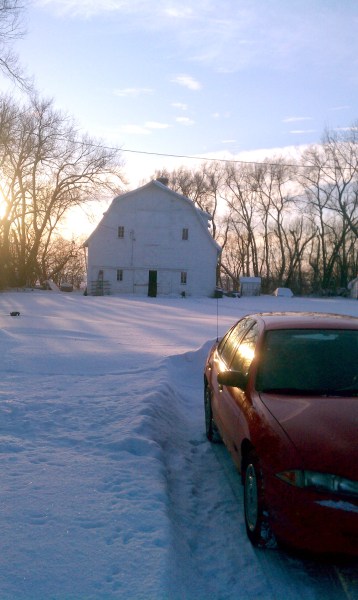

 Our host was Ida Carlson’s grandson, and after Ida retired from the dance hall business his parents kept it going until the 1980s. The heyday of Ida Carlson’s Barn was the 1930s to the 1940s. The barn was built in 1934, specifically to host dances; it — and the outhouse, of course — were the first buildings on the property. Ida got her permit to run barn dances in May 1934 and ads for events at the Barn started appearing in the Moorhead Daily News almost immediately. She applied for a beer license, too, but the county declined, saying having beer and barn dances in the same place “would be against the public interest.” Ida Carlson’s Barn became a popular youth hangout for all the usual reasons that young people needed a place out of town, away from their responsibilities, to hang out with other youths. It’s where people


 Last week Wifey and I were hanging out at our local antique mall when a woman came in wanting to sell a Tupperware full of bits and baubles. Among the jewelry and silverware was a small jewelry-sized baggie full of tokens. Although I’m no help when it comes to jewelry, Wifey was glad I was around to evaluate the tokens. As you may have noticed, money and money-like things are one of the things I collect. The baggie held some generic arcade tokens, a nice Sioux City transit token that went into my collection, a few southeast Asia Playboy Club tokens went into Wifey’s collection, but the rest were a variety of trade tokens.
 The soap coupon tokens I have are also rooted in an earlier type of token: the
  Coupon tokens did survive in some corners well into the twentieth century, particularly if you remember


 About the most unique thing about this bill is that it’s a


 Both of the classic FPD cruisers are Chevrolet Biscaynes, the 1962 seen above and an also-restored 1967. The Biscayne was the low end of the Chevrolet line, with not quite as many bells-and-whistles as the similar Bel Air or Impala. They were reliable and oriented towards the fleet market, which resulted in the Biscayne fulfilling the role of
  Although both cars are still largely in their original form — Claus said that, up until the police department went digital, even the two-way radios were still functional for police business — their age has required a little bit of restoration to stay in top shape. The cost of repairs has been covered through cooperation from the city, the museum, the Claus’ own contributions, and through the support of local businesses. Claus said that, when the 1967 car needed tires, Fargo Tire replaced them for free — and when he brought the 1962 car in today, he didn’t even have to ask; Fargo Tire replaced the tires pro bono. Claus refers to the cars as “ambassadors”, a friendly presence for connecting with the Fargo Police Department and the Law Enforcement Museum. He said that everyone loves seeing the old police car, and people who were around during the 1960s always have a story to tell about them. Claus joked, “but none of them have a story about themselves sitting in the back, of course.”


